What is an Employee Value Proposition?
It answers a question every employee asks themselves, consciously or not: Is this worth it? And right now, it represents one of the biggest opportunities in employee experience.


What is an Employee Value Proposition?
Fauna fundamentals
And why it could transform everything
Imagine you’re a candidate for a global tech company famous for innovative products. You’ve had a fantastic interview and you’re excited to join. Your onboarding introduces you to a fresh thinking working group to capture the new ideas of new starters. A few months in, you’re recognised for having a bold idea. It failed but that didn’t matter. There’s open feedback and ideation channels for employee innovation.
Imagine if every interaction someone had with your organisation told the same story. The same values. The same promise. The same decision-making lens.
Every touchpoint, reinforcing the same message: this is who we are, this is what we value, this is how we show up for our people.
That’s the power of a truly embedded Employee Value Proposition. And right now, it represents one of the biggest opportunities in employee experience.
What’s the deal?
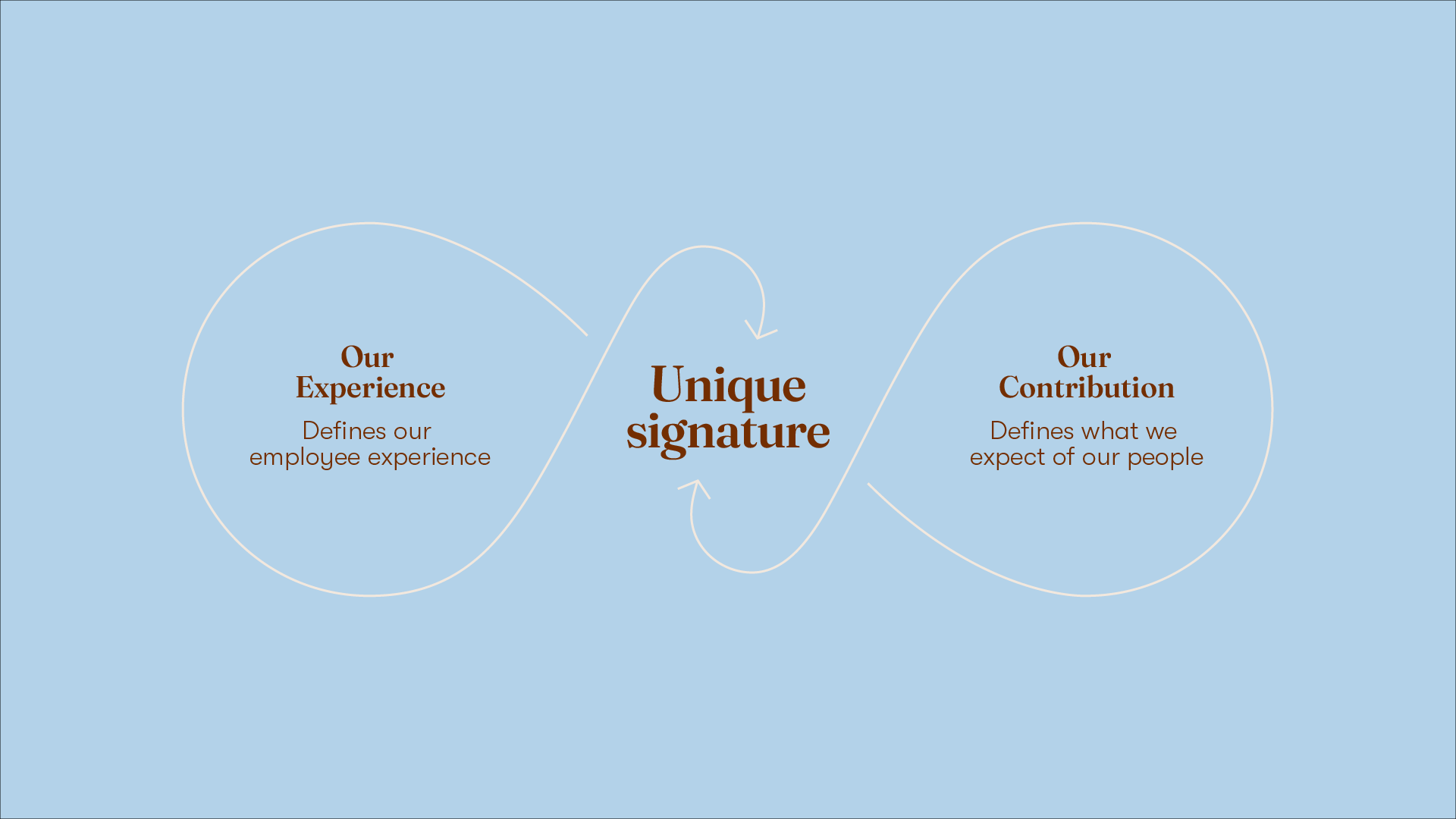
An EVP answers that question. It’s the deal you make with your people. The total value exchange between what someone brings to work every day, their skills, energy, commitment, ideas and, what they genuinely receive in return. Compensation, yes. But also the total accumulation of their experiences at work. We like to call it your unique signature. Nobody can quite replicate it because it’s your organisation, at the most honest core.
It answers a question every employee asks themselves, consciously or not: Is this worth it?
Where do you start?
This is the big question. It feels like too big a project. Too many teams need to be involved. The conversation with the brand team will be too tough. Leaders don’t see the value in it
But developing an EVP can be simpler than you think. Because it’s you. We just need to start articulating it.
A guide to developing your Employee Value Proposition
Curiosity
Authentic EVPs are co-created with the people who live them. Develop a representative employee listening strategy. It can be multi-modal but try to weight it in human-to-human conversations or workshops.
Listen from first hellos to fond farewells. Talk to candidates who turned you down, people who’ve recently left, your new starters.
You’re listening for the stories people tell, the moments they describe, the language they use. You’re listening for what’s aspirational versus what’s already true.
Finding your unique signature
Now you’re looking for the themes. What comes up again and again? Where’s the energy?
Every organisation wants to say they value innovation, collaboration and growth. It’s a bit like having ‘integrity’ as a Value. But what does that mean in practice? What are the specific ways it shows up? What would someone experience that’s different from anywhere else?
A strong EVP also acknowledges trade-offs. If you’re a fast-paced environment, that’s exciting for some people and exhausting for others. If you’re a stable, process-driven organisation, that’s reassuring for some and frustrating for others. Clarity about who thrives here helps attract the right people and helps the wrong people self-select out.
The unifying thought
This is where you bring it to life in language. It can be a rally cry, set of pillars, a narrative, a promise. What matters is that it’s memorable, meaningful, and true.
Test it with employees. Does it resonate? Does it feel like this place? Would they use these words themselves? If it could describe any organisation, sharpen it until it could only describe yours.
A talent tool, or something more?
EVPs can be transformative. But only when we approach them as a strategic and holistic decision-making tool for the employee experiences we design.
Google’s EVP centres on intellectual curiosity and asks candidates “How many golf balls fit in a school bus?”. Patagonia’s EVP is built on environmental purpose and work-life integration. Their benefits include on-site childcare and bail money for employees arrested at environmental protests.
They should be felt before we see them written down. Every touchpoint tells a story.
Consider the employee journey as a series of moments. Each one is an opportunity to demonstrate your EVP in action. It’s the core of experience design. The job advert, the social presence, the onboarding, the development, the career path, the transitions.
A strategic decision-making lens
Your EVP isn’t a one-time project. It’s a living thing that should evolve as your organisation evolves, as your people’s needs shift, as the world changes.
The organisations that get EVP right treat it as an ongoing practice, and a core decision-making lens for your employee experience strategy.
From first hellos to fond farewells. And every moment in between.
The organisations that get this right won’t just have an EVP. They’ll have a promise that people believe, because they experience it every day.